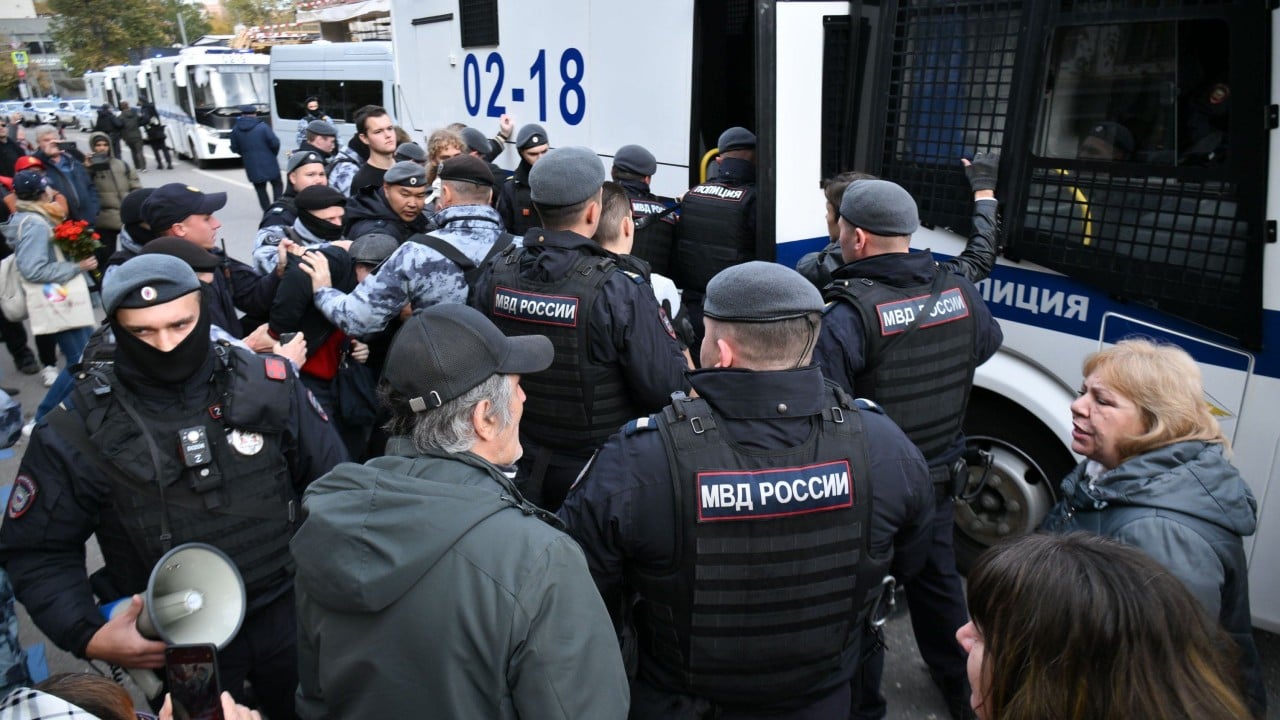
Police in Moscow recently detained around 60 people, primarily young demonstrators, as a public gathering organized by Russia's Kremlin-friendly Communist Party drew to a close. If even a systemic, state-aligned political faction can see its members hauled away by security forces, the boundaries of tolerated dissent in Russia have officially shrunk to nothing.
The demonstration was ostensibly meant to mark the anniversary of the Kremlin’s 1993 military crushing of the Russian parliamentary uprising. Yet, what started as a permitted event quickly fractured. Participants, many of them younger than the political establishment itself, began pushing the envelope. They shouted explosive slogans like "Down with the Tsar!" and "We want freedom," directly challenging the rigid red lines of contemporary Russian politics.
The Paradox of the Kremlin-Friendly Left
For over twenty-five years under Vladimir Putin’s rule, the Communist Party of the Russian Federation has walked a very specific tightrope. They function as the official systemic opposition. They critique domestic economic policies and sometimes vote against minor government bills, but they reliably back the Kremlin on core existential issues, including the war in Ukraine.
Because of this loyalty, they usually enjoy a level of legal protection that radical anti-war or liberal opposition figures could never dream of. They get permits for rallies. They hold seats in parliament. But this recent crackdown reveals a stark reality. When public frustration bubbles over, and when crowds start chanting anti-government slogans or voicing raw anger regarding things like military drone strikes and political repression, the state stops caring about official party affiliations.
Footage from the event showed security forces moving in aggressively as the gathering broke up. At least 60 individuals ended up in police custody. Former Moscow City Duma deputy Yevgeny Stupin noted that arrests spiked rapidly once the chanting shifted toward direct anti-Kremlin rhetoric. Elderly women in the crowd tried to physically block riot police, shouting at officers not to touch younger protesters, while bystanders hurled cries of "Shame!" at the vans.
Why This Crackdown Changes the Calculus
Most analysts treat political rallies in Russia through a binary lens: sanctioned events go smoothly, unsanctioned ones get smashed. This incident shatters that assumption. It proves that a sanctioned event can instantly transform into an unauthorized riot in the eyes of the police the second the microphone picks up unauthorized dissent.
Younger Russians attending these events aren't looking for moderate bureaucratic adjustments. They are expressing raw, unvarnished exhaustion. Slogans recorded at the scene included demands to halt political repression and dismantle corrupt bureaucratic structures. When those voices infiltrate a controlled Communist Party gathering, the state reacts with brute force to restore absolute silence.
You can't play by the rules when the rules change mid-game. The Communist Party thought its institutional safety net would protect everyone in attendance. They were wrong.
Keep an eye on how state media spins these detentions in the coming days. Expect minimal coverage or heavy framing that paints the detained youth as provocateurs who hijacked a peaceful historical commemoration. When even loyalist opposition can't manage its own crowds, public dissent in the capital enters a much colder phase.