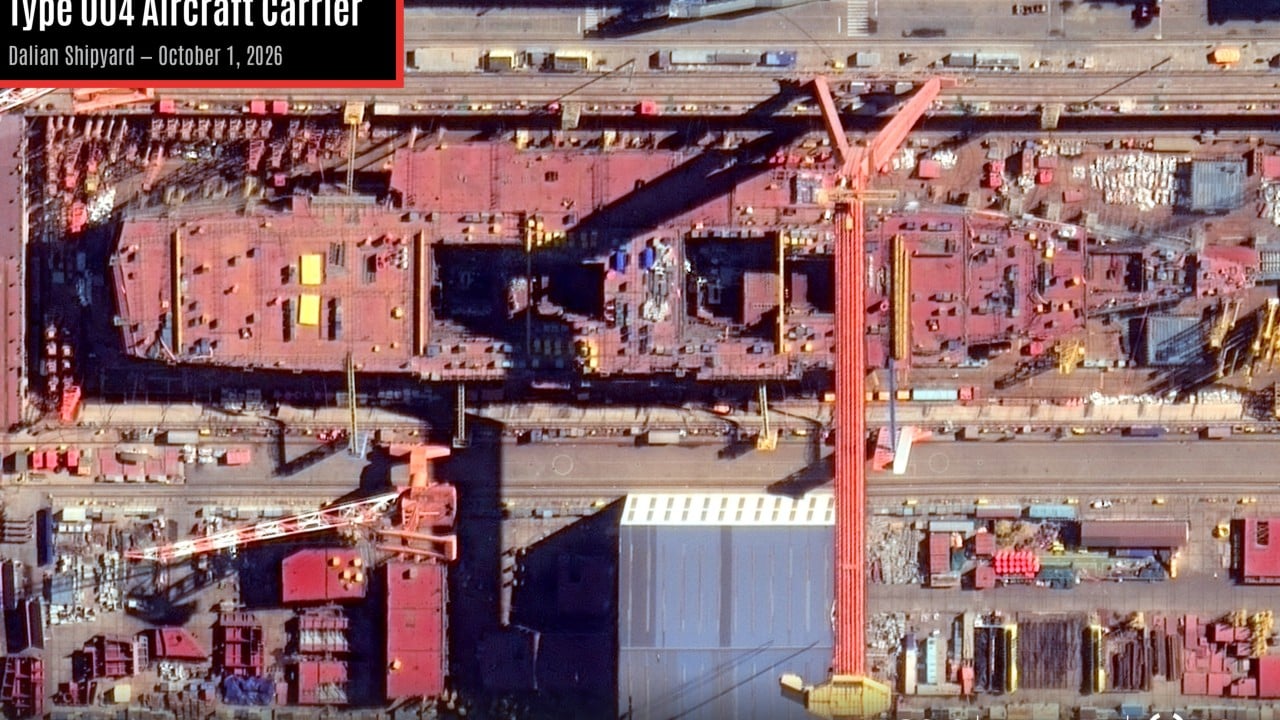
Commercial satellite imagery has completely transformed how we watch military buildups, and nowhere is that more obvious than in Dalian. Recent high-resolution photos of China's fourth aircraft carrier—unofficially designated the Type 004—reveal a hull taking shape at a speed that continues to catch Western defense planners flat-footed. With assembly moving along at the major shipyard in Liaoning province, open-source intelligence analysts are increasingly pointing toward a potential launch window around 2027.
If you look past the usual breathless headlines about naval supremacy, the physical evidence in the dry dock tells a much more technical story about propulsion, scaling, and how the People's Liberation Army Navy (PLAN) plans to operate far from its home waters.
Moving Beyond Conventional Limits
The big question surrounding the Type 004 isn't just when it will hit the water, but what is actually going inside that massive hull. Following the commissioning of the Fujian in late 2025, which gave China its first conventionally powered flattop with electromagnetic catapults, Beijing's engineers have shifted their focus to a much larger beast.
Independent defense analysts reviewing satellite captures from commercial providers have flagged two distinct 15-meter by 15-meter compartments within the ship's lower frame. These spaces exhibit the exact multi-layered architectural hallmarks required for nuclear reactor shielding. In plain English, everything points to China building its first nuclear-powered aircraft carrier.
Nuclear propulsion changes the entire strategic equation for a navy. Conventional carriers like China's Liaoning, Shandong, and Fujian are tethered to logistical supply chains and fuel endurance limits. A nuclear-powered carrier removes those operational bottlenecks entirely. It can sustain higher speeds indefinitely, frees up internal volume previously wasted on aviation fuel bunkers, and generates the massive electrical output needed to run advanced electronic warfare suites and electromagnetic launch systems without breaking a sweat.
Scale, Timing, and the 2027 Milestone
Why is 2027 getting tossed around so often by analysts tracking the Dalian yard? It marks the centenary of the founding of the People's Liberation Army, a symbolic target date that Beijing loves to hit for major military milestones.
However, construction reality dictates that launching a hull is only half the battle. When the hull rolls out or is flooded in dry dock, it's basically an empty steel shell. Fitting out the internal electronics, running reactor tests, installing weapon systems, and conducting rigorous sea trials usually takes several years. Even if the Type 004 touches water in 2027, it won't join active fleet operations until closer to the end of the decade.
The physical dimensions alone are staggering. Measurements taken from orbital imagery show a beam width and overall length that approach the sheer scale of the United States Navy's Ford-class carriers. When you match this hull size with an expanding carrier air wing featuring stealth fighters like the J-35 and airborne early warning aircraft like the KJ-600, the PLAN is systematically checking off every box required for blue-water power projection.
Open-Source Intelligence is Changing the Game
Ten years ago, keeping tabs on a classified naval project meant waiting months for blurry intelligence leaks or official state media announcements. Today, commercial satellites and on-demand tasking platforms allow anyone with an internet connection to watch dry docks evolve in near real-time.
That transparency cuts both ways. While Beijing keeps official design specs under wraps, the physical steel doesn't lie. Every section welded into place at Dalian feeds straight into global military assessments, forcing Washington and its allies to constantly recalibrate their long-term naval budgeting and strategy.
The Type 004 is no longer a paper concept or a rumor on defense forums. It's sitting in a dry dock, growing larger by the month, and signaling a permanent shift in modern naval architecture.