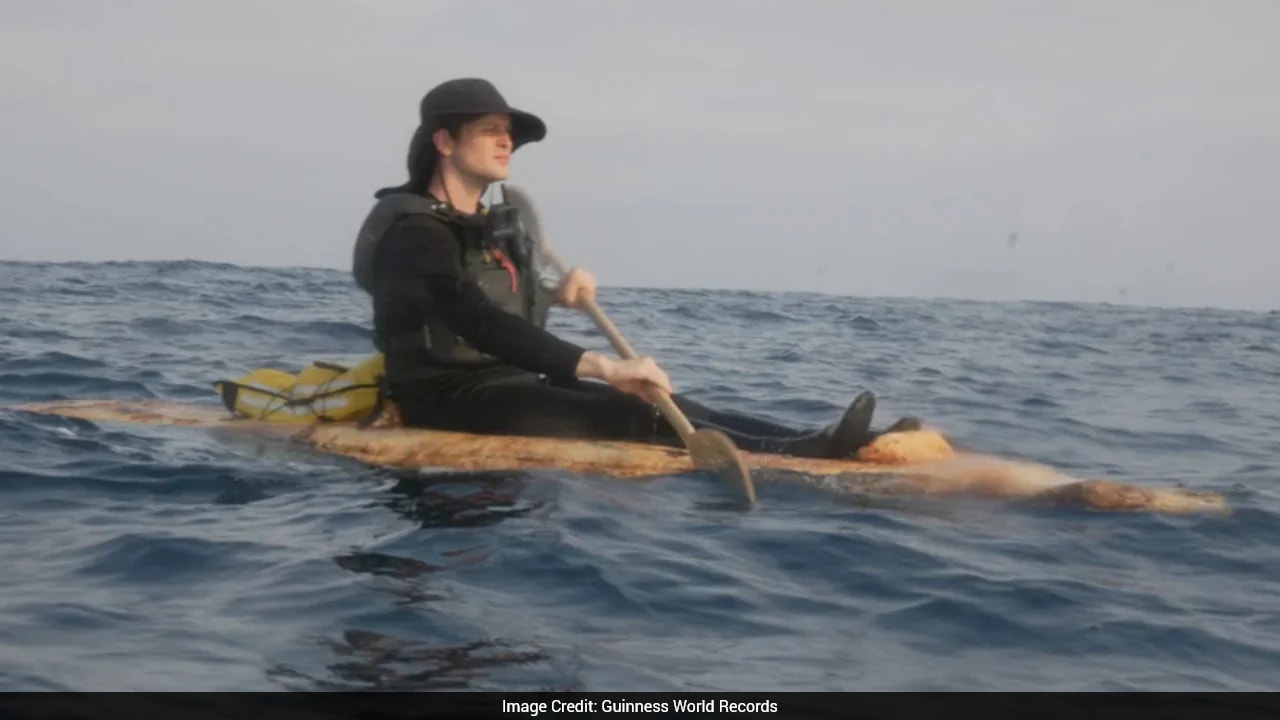
Most people assume fungi belong on a pizza or decomposing on a rotting log in the woods. They certainly do not picture them carrying a human 26 miles across open ocean water. Yet, that is exactly what Los Angeles-based maritime mycologist Sam Shoemaker pulled off when he paddled a 12-foot kayak constructed entirely from fungal mycelium across the treacherous Catalina Channel.
It sounds like science fiction. It is entirely real. And it punches a massive hole in how we think about structural engineering and marine materials.
For over a decade, material scientists and environmental engineers have hunted for viable alternatives to petrochemical plastics and non-renewable fiberglass. They have experimented with hemp, bamboo, algae, and various bio-resins. But fungal mycelium—the root-like network of thread-like hyphae that mushrooms use to grow—offers a unique structural advantage. It grows into complex shapes, binds naturally, and cures into a rigid composite material that rivals traditional manufactured polymers.
Shoemaker did not just theorize about this potential in a white-coated laboratory. He built a watercraft, put his life on the line, and proved that biology can out-engineer petrochemicals in harsh marine environments.
The Reality of Fungal Material Science
Working with fungi requires a complete mindset shift. Grocery store button mushrooms turn to mush in hours when exposed to moisture. If you leave them on a kitchen counter, they rot. If you drop them in salt water, they disintegrate.
Shoemaker avoided this trap by ignoring commercial varieties entirely. Instead, he spent more than ten years experimenting with wild, native, rare, and even poisonous fungi in his studio. Wild polypore mushrooms possess natural defense mechanisms, fibrous cell walls, and dense chitin structures that handle environmental stress differently than cultivated species.
When you dry and preserve specific wild fungal strains correctly, they crosslink into a surprisingly resilient matrix. Chitin is the exact same tough, flexible substance found in the exoskeletons of beetles and crabs. It offers incredible tensile strength relative to its weight.
In 2024, Shoemaker built his first rough prototype using a wild polypore mushroom found growing right outside his Los Angeles studio. That initial boat floated, but it lacked the structural integrity required for open-water navigation. It was a proof of concept, nothing more. To take on the ocean, he needed industrial precision and organic growth working in tandem.
Engineering a Living Hull
Growing a boat is entirely different from molding fiberglass or welding aluminum. You cannot simply hammer mycelium into shape. You have to guide it.
Shoemaker teamed up with his cousin Laza to solve the geometric challenge. They tracked down a standard recreational kayak on Craigslist, bought it, and used it to construct a custom fiberglass mold. This mold acted as a biological scaffold. They filled the negative space with their fungal cultures, feeding the mycelium the right nutrients under controlled humidity and temperature until it completely colonized the interior of the mold.
The organism literally grew into the exact shape of a 12-foot watercraft.
Once the biological growth phase finished, the structure underwent careful drying and preservation treatments. This crucial step halted cellular activity while locking the chitin and mycelium matrix into a rigid composite state. The resulting hull was lightweight, buoyant, and completely organic.
Critics often underestimate bio-composites because they assume organic materials lack fatigue resistance. Ocean water is relentless. Salt water degrades glues, corrodes metals, and exploits micro-fractures in hulls. A fungal hull had to withstand wave action, solar radiation, and hydrodynamic pressure without delaminating or absorbing waterlogged weight.
Crossing the Catalina Channel
Building the mushroom kayak was only half the battle. Paddling it across the Catalina Channel to Cabrillo Beach on the American mainland is a brutal test for any watercraft, traditional or experimental.
Shoemaker pushed off into the Pacific and spent twelve grueling hours on the water. He covered exactly 26.37 miles, translating to roughly 42.43 kilometers of open-ocean transit.
The Catalina Channel is notoriously unforgiving. Paddlers face unpredictable wind swells, deep ocean troughs, and fierce cross-currents whipped up by coastal weather patterns. Throughout the grueling 12-hour crossing, Shoemaker battled strong ocean currents and punishing weather conditions that tested every square inch of his fungal vessel's structural integrity.
To make matters even more surreal, nature decided to provide an escort. During the long transit, a giant fin whale surfaced and traveled alongside the mushroom boat. Imagine sitting inches above the waterline in a craft grown from fungi, watching a massive marine mammal glide through the Pacific swell. It is an experience very few humans will ever claim.
When Shoemaker finally pulled ashore at Cabrillo Beach, he did not just complete a stunt. He secured his place in the Guinness World Records 2027 edition for the longest solo journey by a boat made from fungal mycelium.
Why This Matters Beyond the Record Books
Novelty stunts happen every day. Someone builds a bicycle out of cardboard, or a raft out of plastic bottles. They make headlines for twenty-four hours and fade into obscurity.
This project is different. It points directly toward the future of sustainable manufacturing.
Global industries consume millions of tons of fiberglass, carbon fiber, and epoxy resins every year. These materials do not break down. They sit in landfills for centuries, or break down into microscopic particles that pollute marine ecosystems. Petrochemical boat manufacturing is toxic, energy-intensive, and leaves a permanent footprint on the planet.
Fungal mycelium offers an entirely circular lifecycle alternative. You can grow it using agricultural waste as a food source. You do not need massive petrochemical refineries or high-temperature furnaces. When a mycelium product reaches the end of its useful life, it is biodegradable. It returns to the earth without leaving synthetic toxins behind.
Shoemaker's successful 42-kilometer sea journey proves that fungal composites can handle real-world mechanical stress. If a mushroom hull can survive twelve hours of salt water, wave shock, and hydrodynamic drag across the Catalina Channel, it can handle calmer inland waters, architectural insulation, packaging materials, and interior panels.
What Builders and Designers Get Wrong
Most innovators trying to replace traditional materials make a fundamental mistake. They try to make bio-materials mimic plastic or steel precisely. They try to force nature to behave like a petroleum factory.
That approach always fails. Organic materials have their own unique structural language. Instead of fighting the natural porosity and fibrous nature of mycelium, Shoemaker leveraged its inherent properties. He embraced the natural composite nature of chitin.
If you want to work with biological materials in structural engineering, you have to stop thinking about mass production lines and start thinking about cultivation management. You manage growth parameters, moisture levels, and nutrient distribution. You treat the material like a living system during its formation phase, and like an advanced engineering composite after preservation.
The Road Ahead for Biopolymers
We are standing at the absolute beginning of the bio-fabrication era. Right now, scaling up fungal composites for heavy industrial use remains expensive and technically complex. Growing a 12-foot kayak in a custom fiberglass mold takes time, patience, and meticulous laboratory oversight. You cannot pop one off an assembly line every ninety seconds like a plastic kayak molded in a factory.
However, manufacturing technology evolves rapidly. As researchers refine faster-growing fungal strains, optimize curing agents, and improve water-resistance treatments, production timelines will shrink.
Sam Shoemaker spent over a decade working with everything from glowing forest fungi to rare native toxins just to figure out what these organisms could do. His 12-foot voyage across the Pacific is the opening salvo in a much larger shift.
The next time you look at a mushroom on a decaying log, remember that the same biological blueprint just conquered the open ocean. We have only scratched the surface of what living materials can achieve.