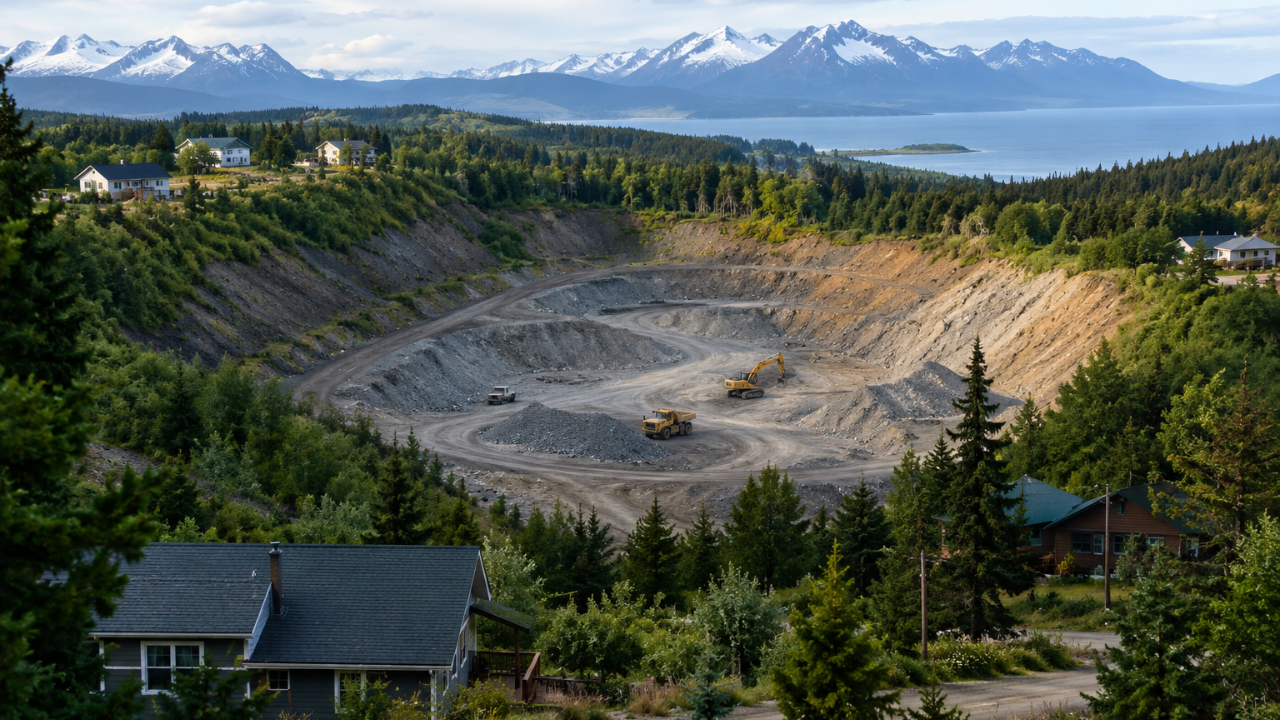
You would think owning private land gives you the absolute right to dig it up. It doesn't. When Beachcomber LLC tried to carve out a 27-acre gravel pit on their 41-72 acre property in Anchor Point, Alaska, back in 2018, they probably expected a routine permit approval. Instead, they triggered an eight-year legal war that ended at the state supreme court.
The core issue wasn't just about hauling rocks or standard industrial zoning. It was about acoustic geometry. The proposed gravel mine sat right inside a natural, amphitheatre-style depression. Neighbours took one look at the bowl-shaped terrain and warned local officials that the land would act like a massive megaphone, amplifying heavy machinery noise straight into nearby homes where sound barriers wouldn't stand a chance.
Why Topography Trumps Paper Permits
Local planning codes usually operate like a checklist. If an applicant meets specific criteria—like preserving green buffers or building earthen berms—the permit usually gets stamped. Beachcomber followed this exact logic through multiple rounds of administrative ping-pong.
First, the Kenai Peninsula Borough Planning Commission rejected the initial 2018 application by a 6-3 vote after nearly thirty residents spoke out against the dust, noise, and visual blight. Then, a hearing officer stepped in, ruled that the commission lacked the discretion to block a compliant project, and forced a do-over. The commission approved the permit in June 2019.
That is when neighbour Hans Bilben and local residents dragged the fight into the Alaska Superior Court. They won a reversal in 2021, proving that local authorities actually possess the teeth to deny projects if standard mitigation measures simply won't work in reality. The commission looked at the evidence again, brought in LiDAR elevation data, and rejected the permit a second time in March 2022.
The Supreme Court Decision and What It Means
By the time Beachcomber LLC v. Kenai Peninsula Borough Planning Commission reached the Alaska Supreme Court, the legal battle had evolved into a high-stakes test of municipal power.
On October 23, 2026, the state supreme court delivered its final verdict, upholding the lower court rulings and the commission's denial. The justices made it clear that municipal codes give planning bodies the authority to say no when substantial evidence proves that noise and visual impacts cannot be adequately controlled.
The court dismissed arguments that public opposition alone drove the decision, pointing instead to hard geographic proof. LiDAR scans and resident testimony showed that acoustic bouncing inside a bowl-shaped terrain cannot be neutralized by standard dirt berms or stray patches of lingering trees.
The Real Takeaway for Property Rights and Communities
If you own rural land, this ruling sets a striking precedent for how local governments weigh industrial ambitions against neighbourhood preservation. Meeting baseline zoning checkboxes doesn't guarantee you a victory if the physical layout of your property poses an uncontrollable nuisance to the surrounding area.
Communities fighting unwanted commercial encroachment now have supreme court backing to demand granular geographic scrutiny. Topography matters just as much as zoning text.
Check your local municipal ordinances before buying rural acreage for commercial resource extraction. If the land has unique topographical traps, expect your neighbours and planning boards to use those exact features to lock down your permits permanently.