You can't solve a relentless maritime pressure campaign by simply burning through fuel and manpower. That is the exact trap facing Taiwan's defense and coast guard planners every single day. Beijing relies on constant, low-intensity intimidation—sending unmarked vessels, dual-use fishing boats, and uncrewed hardware right up to the line of ambiguity. It's a strategy designed to wear defenders down without triggering open conflict. Traditional patrol boats are expensive to run, crews get exhausted, and human operators can only look at so many screens at once before fatigue sets in.
That reality is forcing a radical shift in how Taipei approaches security. Instead of matching every single civilian or paramilitary hull with an equivalent crewed ship, Taiwan's Ocean Affairs Council is backing a push toward artificial intelligence and coordinated autonomous drone networks.
The Mechanics of Smart Maritime Surveillance
Running security across choppy open waters means dealing with vast blind spots. Traditional ship-mounted radar systems are constrained by the physical horizon, typically cutting off detection ranges at around ten kilometers. When you are tracking fast-moving or deceptive traffic across the Taiwan Strait, ten kilometers gives you virtually zero reaction time.
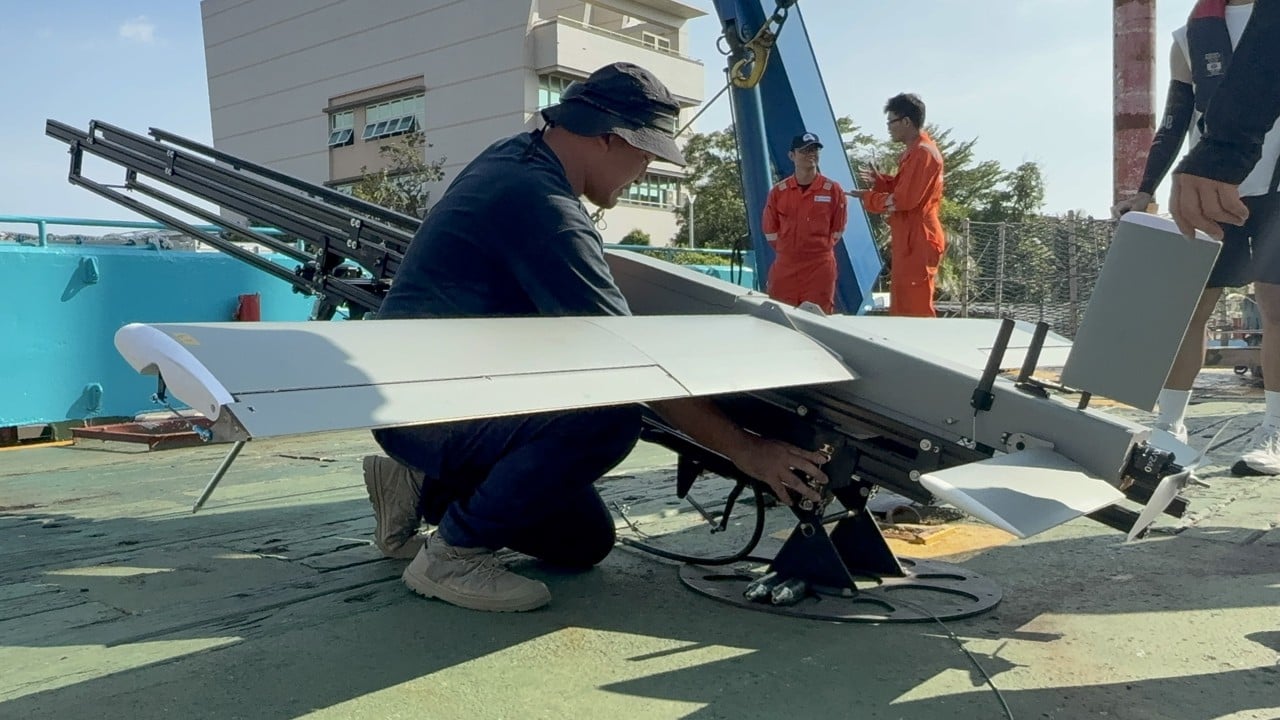
To fix this, researchers at National Cheng Kung University have been simulating and testing multi-drone coordination models funded by the ocean council. They are looking at how different aircraft types—such as vertical take-off and landing platforms like the Jump 20, V-Bat, and Flexroter—can fly together in synchronized formations.
The goal isn't just to put a few cameras in the sky. It's about building an algorithmic control model that manages spacing automatically. Recent simulations involving groups of 20 drones focus heavily on collision avoidance, maintaining a strict vertical interval of roughly 30 meters between aircraft while they sweep wide ocean sectors. By shifting the workload to autonomous systems, operators extend their line of sight far beyond the horizon without risking human crews or burning heavy fuel reserves.
Escaping the Attrition Trap
When thousands of vessels transit regional waters, separating legitimate commercial traffic from covert harassment is a nightmare. Many actors deliberately manipulate their Automatic Identification System data, going dark, spoofing identities, or masking movements to test response times.
Human analysts get overwhelmed quickly when forced to manually verify every single anomaly. Autonomous aerial reconnaissance changes the economics of this game. Instead of dispatching expensive patrol cutters to check every suspicious blip, security teams can cue automated drones to investigate vessels that switch off their tracking beacons or behave erratically.
Analysts like Shu Hsiao-huang from the Institute for National Defense and Security Research have pointed out that uncrewed platforms offer the extended loiter time and stability needed to handle strong coastal winds. When you can keep eyes in the air for hours without interruption, the cost of surveillance drops dramatically. More importantly, it keeps human crews rested and ready for genuine emergencies rather than chasing shadows.
Moving Beyond Theory Into Open Water
Simulations on a computer screen are easy. Saltwater, sudden squalls, and heavy electromagnetic interference are entirely different beasts. The National Cheng Kung University team has cleared initial three-dimensional modeling and aerodynamic testing phases, but the real test is hardware integration.
The upcoming phases require rigorous hardware-in-the-loop trials and open-water flight tests across varied sea conditions. Building a reliable smart maritime defense line means proving that autonomous networks can handle signal loss, severe wind shears, and coordinated tracking without constant human hand-holding.
The broader lesson here is simple. Defensive resilience in modern security isn't about matching an adversary ship-for-ship or plane-for-plane. It's about outsmarting the math of exhaustion by letting machines handle the monotonous, wide-area scanning while humans focus on high-level decisions. If Taiwan's autonomous swarm projects successfully scale from university labs to active frontline deployment, it will fundamentally alter how smaller nations push back against relentless grey-zone pressure.
Stop looking at traditional naval parity as the only metric of defense. The future belongs to those who can see further, cheaper, and entirely autonomously.