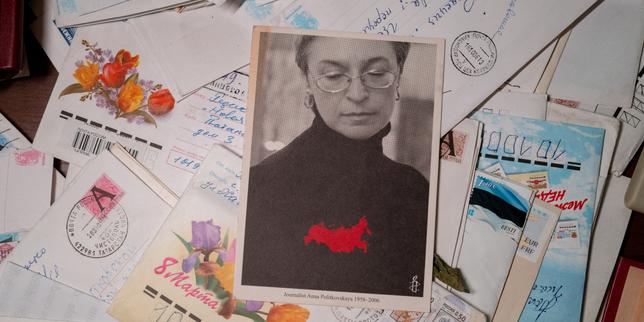
Two decades have passed since Anna Politkovskaia was gunned down in the stairwell of her Moscow apartment building. Her execution took place on October 7, 2006—deliberately timed on Vladimir Putin's birthday. Twenty years later, her uncompromising voice refuses to stay buried in the past. It has returned in fiction, infiltrating the very mind of a Kremlin propagandist in Jean-François Bouthors' striking new novel, La Vengeance d’Anna P. published by Éditions Noir sur Blanc.
Most books about Russian authoritarianism rely on dry political analysis or distant historical overviews. They look at state-sanctioned media from the outside, treating propaganda as a simple broadcast tool. Bouthors takes a different route entirely. By letting the spirit of the murdered Novaya Gazeta journalist slip inside the head of a fictional Kremlin spin doctor named Oleg, the book exposes the psychological machinery behind modern autocracy. It isn't just about what state media says. It's about how the people writing those lies justify them to themselves.
Oleg thinks he controls the narrative. He shapes the news cycles, sanitizes brutal military campaigns, and spins geopolitical grievances into patriotic fervor. Then Anna P. enters his consciousness. She doesn't arrive as a quiet specter seeking pity. She arrives as an unyielding interrogator, dismantling his rationalizations piece by piece. Through fierce internal dialogues, she forces him to confront the human cost of the machinery he serves.
The turning point in the novel comes when Oleg crosses paths with Lioudmila, a literature teacher devoted to the persecuted poet Osip Mandelstam. Through Lioudmila, the comfortable myths Oleg propagates about Ukrainian history and Russian supremacy begin to crumble. He learns that the official state version of history is built on quicksand. It is a powerful reminder that literature and historical memory remain dangerous threats to totalitarian systems, capable of puncturing the thickest bubbles of state denial.
Why does this narrative device matter so much today? Because modern propaganda doesn't just convince people to believe falsehoods. It exhausts critical thinking until truth feels entirely irrelevant. When journalists are silenced through bullets, exile, or intimidation, the state tries to write history uncontested. Books like La Vengeance d’Anna P. prove that memory outlives assassination. Politkovskaia's legacy isn't confined to a tragic obituary. It remains an active, disruptive force challenging those who trade truth for power.
If you want to understand how authoritarian regimes manufacture consent and how internal doubt creeps into the minds of their enfauteurs, look past the daily headlines. Read the stories that give shape to the ghosts of those who refused to look away.