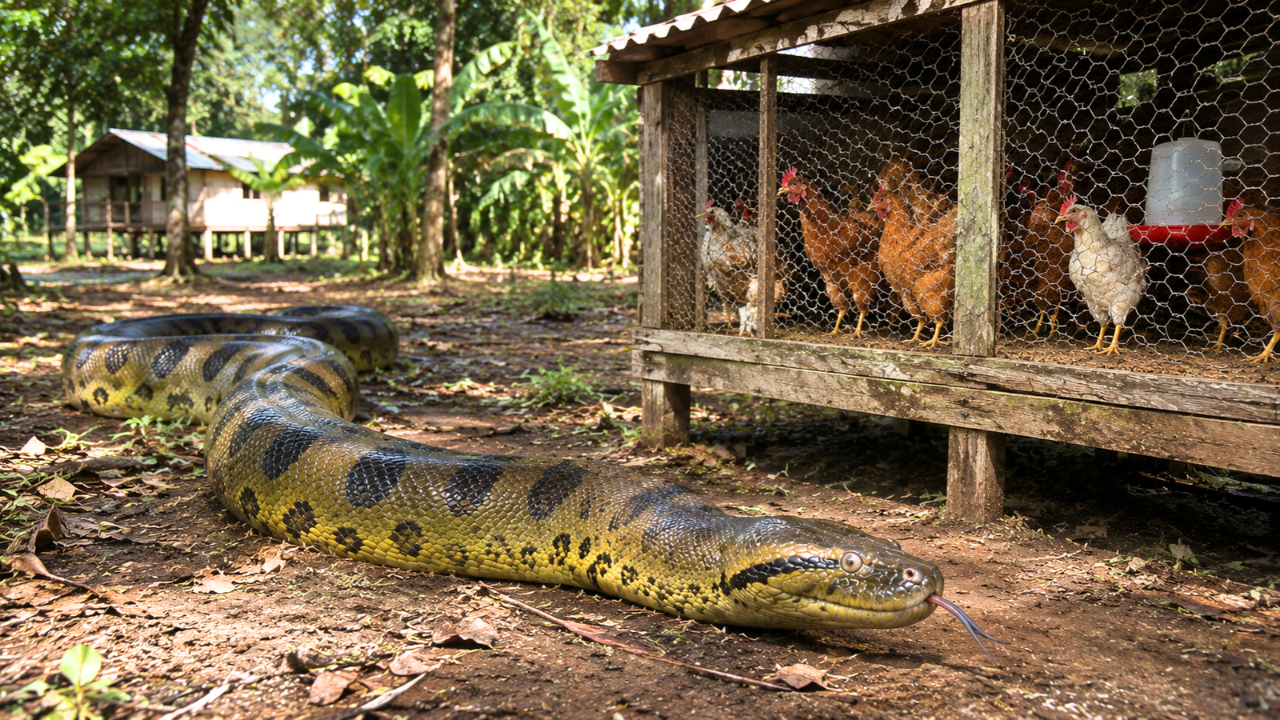
Big snakes and small farms make terrible neighbors. When a twenty-foot anaconda slides out of an Amazonian river and raids a backyard poultry pen, the resulting clash is brutal and predictable. Farmers lose their primary source of protein and income, and the snake usually loses its life.
It is easy to point fingers from a distance. Urban conservationists often blame rural villagers for killing these apex predators out of spite or ignorance. That view misses the ground-level reality. If your family relies on a dozen laying hens to survive the week, a massive water boa treating your chicken coop like an all-you-can-eat buffet creates an immediate crisis. You do not wait for an environmental committee to convene. You grab a machete.
Ecologists and field researchers working in South America have started looking past the finger-pointing to examine the mechanics of these conflicts. Recent studies show that this is not about senseless cruelty. It is a predictable clash over resources born from poor infrastructure. Fortunately, the solution does not require shooting giant snakes or abandoning small-scale farming. It requires better wire mesh.
Why Anacondas Target Backyard Poultry
Anacondas do not wake up hunting chickens. In their natural habitat, these heavy-bodied constrictors lie in wait near slow-moving rivers and flooded forests for capybaras, wild pigs, caimans, and deer. They are ambush predators built for high-reward, high-energy meals.
Human expansion changes the math. As villages grow along riverbanks, people clear brush and build homes right on the water's edge. They keep livestock in makeshift enclosures made from loose wood slats, chicken wire stretched over flimsy frames, or open-air pens raised a mere foot off the damp earth.
To an anaconda drifting downriver at night, a traditional Amazonian chicken coop smells like an easy pantry. The birds crowd together, panic loudly, and cannot escape. A single large snake can swallow multiple chickens in one sitting, making these unsecured yards far more rewarding than hunting skittish wildlife in the dense brush.
The Human Cost of Coexistence
Conservation is a luxury of the well-fed. When a farmer loses half their flock in a single night, the financial blow cuts deep. Eggs and poultry are currency in remote settlements. They trade for goods, pay for school supplies, and provide vital daily nutrition in areas where grocery stores do not exist.
When scientists talk about preserving biodiversity, rural communities often hear a different message. They hear that wildlife matters more than human livelihoods. That friction turns an ecological challenge into a cultural war. Villagers kill anacondas not because they hate nature, but because they feel defenseless.
Blaming the locals solves nothing. Telling a farmer to simply tolerate losing livestock to an eighteen-foot reptile ignores basic economic survival. If conservationists want to save the snakes, they have to protect the chickens first.
How Structural Changes Stop the Attacks
Researchers analyzing rural predation patterns found a bright spot. Most snake attacks on domestic livestock share a common flaw: total lack of physical exclusion. Traditional coops are built to keep chickens from wandering off, not to keep determined predators out.
Upgrading these structures requires shifting from containment to fortification. Simple engineering changes completely alter the dynamic between farmyards and river predators.
- Raising coops off the ground on smooth metal or concrete pillars stops ground-dwelling constrictors from sliding underneath or prying open floorboards.
- Replacing flimsy netting with heavy-duty welded wire mesh prevents snakes from forcing their way through gaps in the walls.
- Clearing dense vegetation and brush within twenty feet of the coop removes the cover anacondas rely on to approach unseen under the cover of darkness.
These adjustments cost very little compared to the ongoing losses of livestock. When a coop becomes impenetrable, anacondas stop visiting. They move back into the wetlands, hunting native prey instead of domestic poultry.
Bridging the Gap Between Science and Survival
Protecting wildlife in human-dominated landscapes requires practical collaboration. Researchers cannot simply drop off brochures and walk away. Successful projects involve working directly with villagers to redesign pens, source stronger materials, and demonstrate that coexistence is cheaper and safer than constant conflict.
Killing a giant anaconda is dangerous work. These animals possess immense strength and can easily injure an unprepared person in the muddy confines of a backyard. Finding out that a simple hardware fix can eliminate the need for dangerous wildlife combat comes as a relief to many rural families.
Human-wildlife conflict is rarely about malice. It is almost always about proximity and protection. By shifting focus from punishing farmers to upgrading farm infrastructure, conservationists and villagers can finally share the riverbanks in peace.
Take a hard look at your own animal enclosures, whether you live in the Amazon or a suburban backyard. Secure your perimeter before predators find the weak spots, and you will never have to choose between your livelihood and the wildlife outside your door.