I couldn't access that Times of India page directly because of a fetch error, so I'm working from the headline's core angle and what we actually know about computational complexity and modern cryptography.
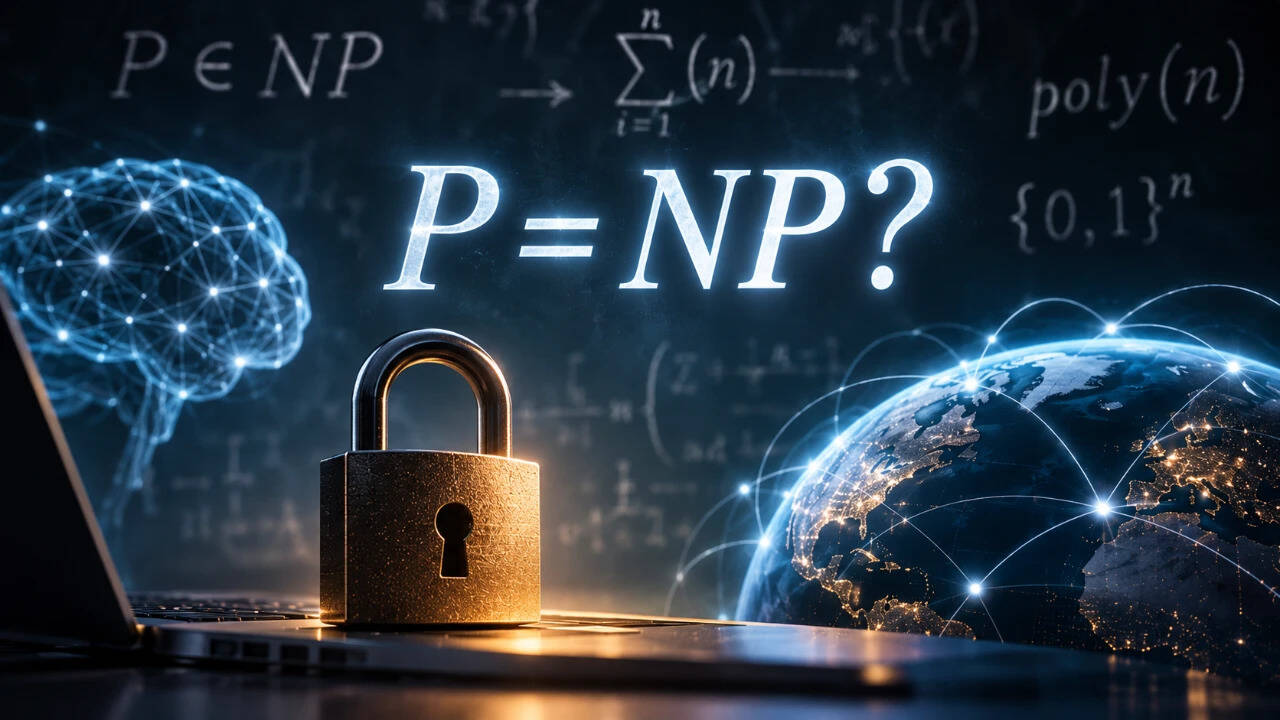
Here's the blunt truth. AI isn't about to solve the P vs NP problem and instantly shatter global encryption.
That sounds dramatic on a news ticker. AI cracks math's biggest mystery and exposes every secret on earth. Fun headline. Bad security engineering. When people hear that P vs NP might fall to neural networks or automated theorem provers, they picture bank vaults popping open overnight and encrypted chats turning into plain text before lunch. Honestly, that's not how complexity theory works, and it's not how real-world ciphers fail first.
Let's unpack what P vs NP actually means, why headlines keep inflating AI's threat to encryption, and where real cryptographic risks actually live right now.
What P vs NP Actually Means Without the Math Jargon
At its core, P vs NP is a question about speed and checking work.
If a problem is in P, a computer can solve it quickly. Quick here means polynomial time, so as the input grows, the runtime scales in a manageable way rather than blowing up into trillions of years. Sorting a list of names or multiplying two large numbers sits comfortably in this camp.
If a problem is in NP, a computer might take forever to find a solution from scratch, yet once someone hands you a candidate answer, you can check whether it's right pretty fast. Think of a giant Sudoku grid or a complex schedule. Finding the right arrangement can be brutal. Checking a completed grid takes seconds.
The P vs NP problem asks whether every problem whose solution can be checked quickly can also be solved quickly. Most computer scientists bet that P does not equal NP. Still, nobody has proven it. The Clay Mathematics Institute lists it as one of the seven Millennium Prize Problems, with a $1 million prize waiting for a rigorous proof either way.
Notice what's missing from that definition. There's no magic button labeled "AI" that turns a non-constructive hunch into a formal mathematical proof. AI systems have helped mathematicians spot patterns, test conjectures, and propose candidate steps in specialized proofs. That's genuinely cool. Going from pattern hints or heuristic guesses to a rock-solid proof that settles P versus NP is a completely different mountain.
Why Headlines Link P vs NP Straight to Broken Encryption
I've spent years looking at threat models around applied security, and one mistake shows up constantly. People treat "hard to break" as a synonym for "proven NP-complete."
Those aren't the same thing.
Many widely used encryption schemes rely on problems believed to be hard—like integer factorization or discrete logarithms over elliptic curves—rather than proven NP-complete problems. Even if someone proved P equals NP tomorrow, a theoretical existence proof wouldn't automatically hand you a fast, practical algorithm with small constants that runs on today's hardware. A polynomial algorithm with a degree like $n^{100}$ is still a theoretical win and a practical dud.
Even more importantly, even if P equals NP, one-way functions might still exist in a practical sense or might not. Cryptography cares deeply about worst-case versus average-case hardness, key lengths, side channels, and implementation bugs. Real attackers rarely need to break pure mathematics when a misconfigured server, a leaked private key, or a weak random number generator gives them a much easier door.
Still, you can see why the story hooks readers. Encryption protects money, medical records, government cables, and private messages. Tell people those locks might come off, and they'll click immediately. The gap between "AI makes progress on math problems" and "global encryption collapses" is wide enough to drive a truck through.
How AI Actually Affects Cryptography Right Now
If P vs NP isn't the immediate bomb, what is AI actually doing to security?
First, AI helps defenders and attackers write code faster, spot logic flaws, and analyze traffic patterns. That's practical software and systems work, not breaking AES or RSA by pure math magic.
Second, AI can speed up narrow search tasks, cryptanalysis experiments, and side-channel modeling in lab settings where researchers test weaknesses in specific implementations. Stronger hardware and smarter algorithms always push key sizes and cipher choices forward over time.
Third, the bigger long-term cryptographic shift talked about across security teams isn't P vs NP falling to AI. It's quantum computing threatening public-key algorithms like RSA and elliptic-curve cryptography over the coming years, which is why standards bodies like NIST have been rolling out post-quantum cryptography standards.
Here's a classic trap I see teams fall into. They chase sci-fi scenarios—like a sudden math breakthrough nuking every cipher at once—while ignoring basic hygiene like unrotated keys, weak TLS settings, or unpatched edge devices. That's backwards.
Misconceptions That Trip Up Smart People
Let's clear up a few stubborn myths before they waste your time or budget.
- Myth one: Solving P vs NP means instant decryption of everything. Not automatically. Even with a proof, turning theory into a fast attack against real keys isn't guaranteed, and symmetric encryption like AES behaves differently from public-key systems anyway.
- Myth two: AI is basically a proof-solving oracle now. AI tools can assist with brainstorming, formalization checks, or narrow sub-problems, yet formal verification still demands strict logical rigor where a single subtle slip breaks the whole argument.
- Myth three: If P vs NP isn't solved today, you don't need to upgrade anything. Bad take. Cryptographic algorithms age, libraries get deprecated, and organizations that wait until a crisis hits end up rushing migrations under pressure.
One thing I find surprising whenever I explain this to non-specialists is how calm seasoned cryptographers usually are when sensational math headlines hit. They've seen plenty of dramatic claims over the years. They look at concrete attack surfaces, migration timelines, and tested primitives instead of hype.
What You Should Actually Do Next
You don't need a complexity theory degree to make smart security moves today. Focus on things that actually reduce real risk right now.
- Audit where encryption lives in your stack. List where TLS, API keys, database encryption, and token signing are used, and check which libraries and protocol versions are still running.
- Fix boring operational gaps first. Enforce strong key management, rotate credentials regularly, turn on multi-factor authentication everywhere, and patch exposed services promptly.
- Track post-quantum readiness without panicking. Follow guidance from NIST and your cloud or software vendors so you know when your dependencies support quantum-resistant algorithms.
- Read math and AI news with a critical filter. Separate real research milestones from headline hyperbole—especially whenever a story claims one breakthrough will instantly upend global security.