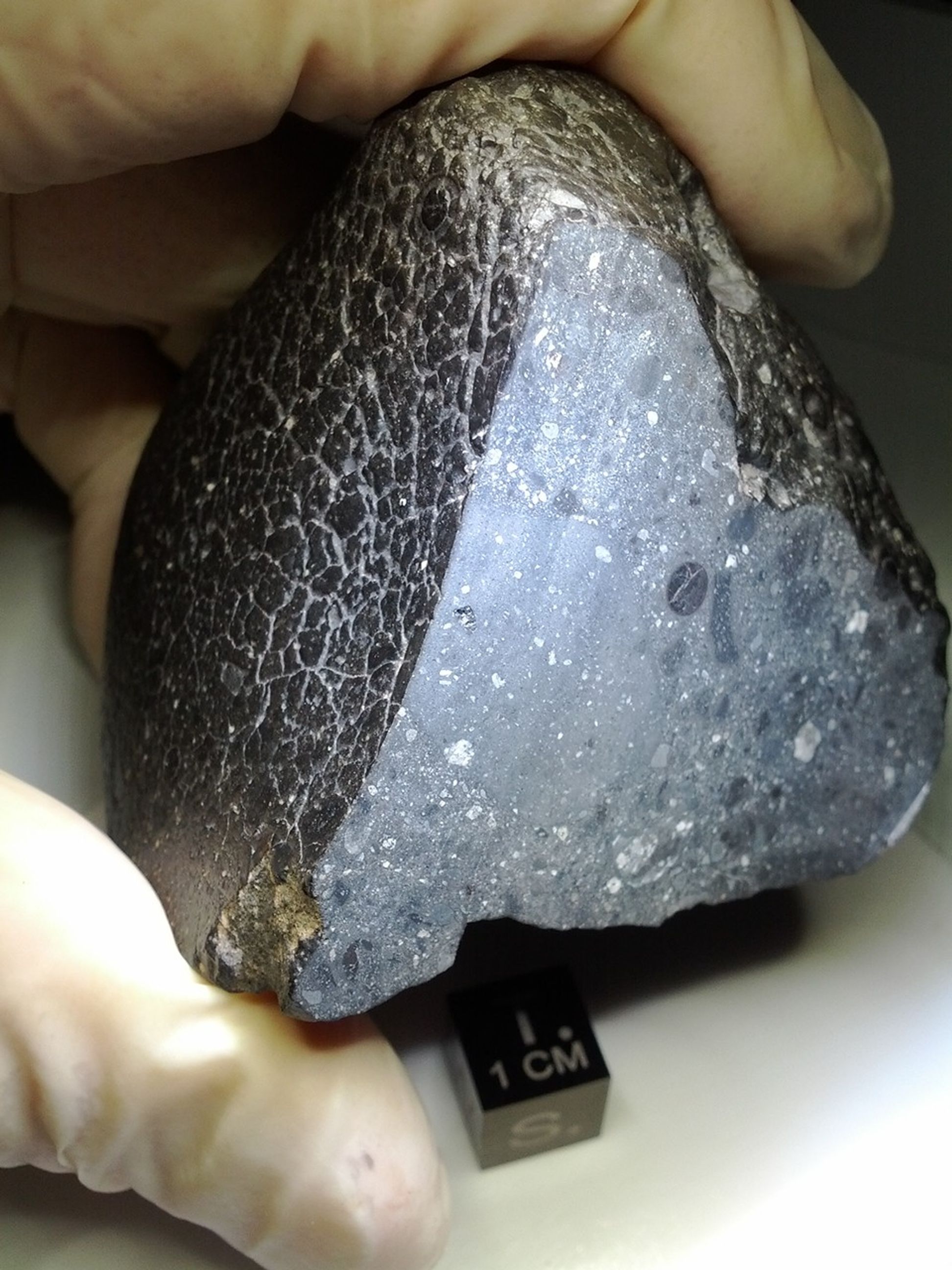
Out in the endless sand dunes of the Sahara, hunters stumbled on a strange, rose-colored rock back in 2022. It didn't belong on Earth. Scientists have now confirmed that this roughly 800-gram specimen, officially named Teghaza 001, is a direct chunk of the Martian crust formed more than 4.1 billion years ago. If you think it's just another expensive space rock, you're missing the bigger picture. This thing is basically a time capsule from an era when Mars might have actually looked and felt a lot more like our own home planet.
Most Martian meteorites we've found so far are young—relative pipsqueaks only a few hundred million years old. Teghaza 001 breaks that mold entirely. Researchers used a cutting-edge, in-situ rubidium-strontium age-dating technique on a sliver smaller than a fingernail to pin down its incredible age. What they found inside rewrites our understanding of the Red Planet's chaotic infancy. For a different perspective, check out: this related article.
The Rosetta Stone of the Red Planet
Why are planetary scientists losing their minds over this specific piece of debris? Simple. We've sent rovers like Perseverance and Curiosity all over Mars, but they've only scratched the surface of specific craters and plains. They can't dig up pristine crust from the deep southern highlands where the planet's oldest secrets hide.
Teghaza 001 solves that geographic blind spot. By analyzing its unique mixture of volcanic minerals and zircon crystals, a team led by NASA's Jet Propulsion Laboratory realized this rock matches orbital data from Mars' ancient southern highlands. It's an actual physical sample from a region no rover has ever touched. Further reporting on this trend has been provided by MIT Technology Review.
Think about what that means. Instead of relying purely on remote sensing or bounced laser signals from orbiters, scientists can hold the actual rock in their hands. They can measure its chemistry down to the atomic level.
What Water Actually Did to Early Mars
The most fascinating part of the new study isn't just that the rock is ancient. It's what happened to it after it formed.
When researchers examined the mineral grains, they found clear signs of aqueous alteration. Water didn't just pool on the surface of early Mars. It percolated deep into the cooling crust, reacting with hot rock, circulating through hydrothermal systems, and leaving chemical fingerprints behind.
Data shows that fluids enriched in specific oxygen isotopes interacted with the rock deep underground around 4.1 billion years ago. This points to a dynamic, active water cycle during a time when Earth was also just starting to figure out how to host life. While our planet took one path toward becoming a blue, vibrant oasis, Mars went the other direction. Teghaza 001 captures that exact fork in the road.
How Scientists Date a Rock From Another World
Doing geochemistry on a meteorite that traveled millions of miles through space isn't easy. Teams at institutions like Caltech had to deploy hyper-precise micro-analytical methods to study tiny mineral domains without destroying the sample.
By targeting tiny domains within the rock, researchers measured the radioactive decay of rubidium into strontium right where the minerals sat. This in-situ approach avoids the contamination risks of older bulk-crushing methods. It lets geochemists look straight past Earth's weathering and isolate the pristine Martian signature locked inside for eons.
The results match independent analyses of the rock's hydrogen and oxygen isotopes, confirming that the fluid alterations happened on Mars before an ancient impact blasted the fragment into space, eventually sending it hurtling toward the Malian desert.
The Big Picture for Future Exploration
We are living through a golden age of planetary science, but physical samples remain the ultimate gold standard. Teghaza 001 proves that you don't always need a multi-billion-dollar sample-return mission to get your hands on ancient Martian geology. Sometimes, space delivers the samples right to our backyard.
As researchers continue to study how this rock interacted with Mars' early atmosphere and escaping water, the narrative of our solar system keeps shifting. Mars wasn't always just a dry, rusty wasteland. For a brief, crucial window of time, it was a dynamic world with active volcanism, circulating fluids, and the ingredients necessary to make things interesting.
Keep an eye on these lab results. Every new mineral grain analyzed brings us one step closer to solving the puzzle of why two planets sitting side by side ended up with such wildly different fates.