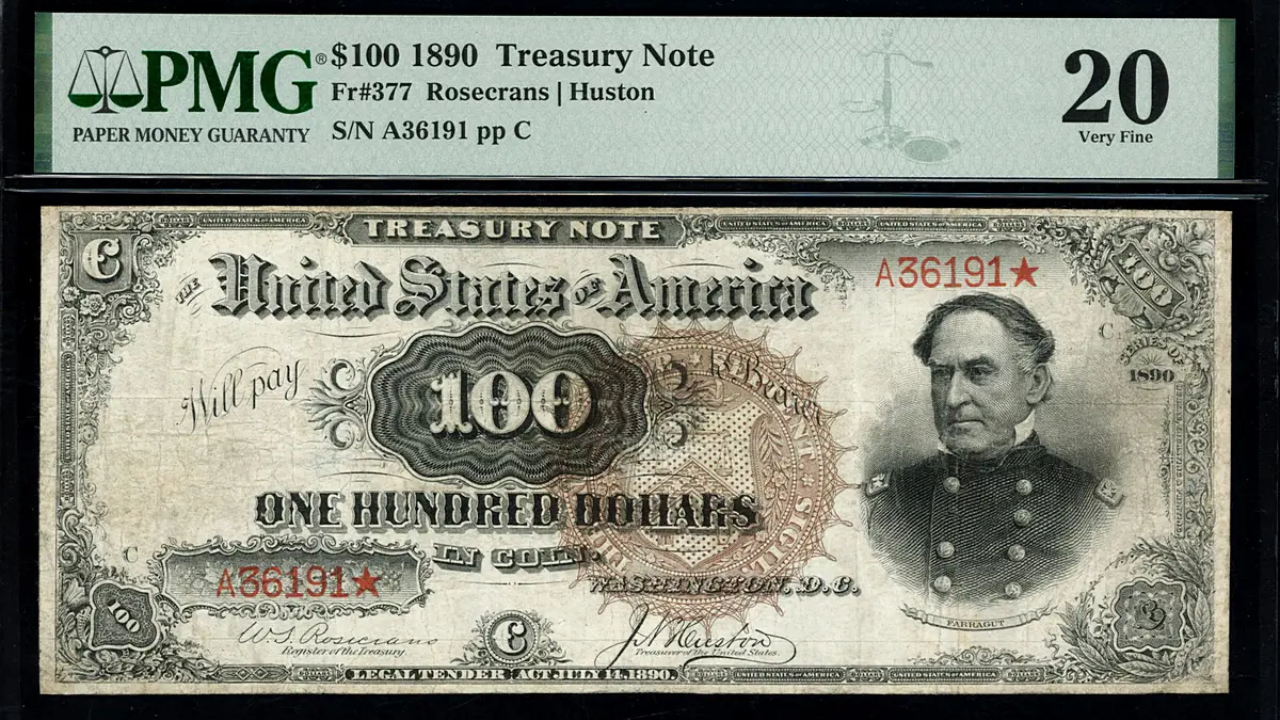
You have probably never seen a $100 bill that looks like a vegetable. But back in 1890, the United States Treasury accidentally created one of the most recognizable pieces of American history. It’s known as the "Watermelon" note.
Most people today assume that government money has always been boring, static, and predictable. That’s a mistake. Money is often a reflection of the political chaos of its time. The 1890 Treasury Note is the perfect case study. It wasn't just a currency design choice; it was a byproduct of the Sherman Silver Purchase Act, a massive piece of legislation that forced the government to buy millions of ounces of silver every month.
The Treasury needed a way to pay for all that metal. They printed these specific notes to bridge the gap.
Why The Nickname Stuck
If you look at the back of an 1890 $100 Treasury Note, you’ll immediately see why collectors call it a Watermelon. It isn’t just a slight resemblance. The reverse side features two enormous, rounded zeroes. The intricate, spiraling lathework inside those zeroes looks remarkably like the rind and pattern of a watermelon.
Bankers in the 1890s weren’t trying to be funny, but the name caught on instantly.
This isn't the only weird name in the hobby. The $1,000 version of this series is known as the "Grand Watermelon." If you ever get the chance to see one in person, take it. These aren’t just pieces of paper; they’re symbols of a time when the government was trying to balance the interests of gold standard proponents and silver advocates. It’s a messy, expensive history lesson you can hold in your hand.
The Brutal Reality Of Survival Rates
Here is the part most articles skip. The government didn't intend for these to become high-priced antiques. They were intended to be used. They were spent, folded, shoved into wallets, and eventually worn down.
The Bureau of Engraving and Printing produced 120,000 of these $100 notes. That sounds like a lot until you realize that, according to industry census data, only about 35 are known to exist today.
Let that sink in.
The survival rate is essentially a rounding error—roughly 0.03%. Most of the original print run went into government incinerators as the notes became tattered or outdated. When you hear about one coming to auction, you aren’t looking at a "rare" item in the sense that a new smartphone is rare. You’re looking at something that technically shouldn’t exist at all.
What Collectors Look For
If you are thinking about entering the world of high-end currency collecting, the 1890 Watermelon is the "holy grail" tier. But you have to know how to look at them.
- The Grade Matters: You’ll see notes graded by services like PMG. A "Very Fine" note with professional restoration is a completely different asset than a "Choice Uncirculated" note. Don't let a fancy name distract you from the physical condition.
- The Backstory: Provenance is everything. A note with a documented history—like those from famous family collections—commands a premium. You’re buying the paper, but you’re paying for the pedigree.
- The Design Shift: The Treasury realized quickly that the dark, intricate patterns on the back were actually a security failure. They were so busy that it was hard for bank tellers to spot counterfeits. By 1891, they scrapped the design for a simpler "Open Back" version. This one-year window is exactly why the 1890 series is so valuable.
Why This Should Interest You
You don’t have to be a multi-millionaire to appreciate this. The Watermelon note is a masterclass in risk and policy. It’s evidence that even the most "official" government systems are prone to trial and error.
If you want to start collecting, start by studying the census reports. Look at the Track & Price records. Stop focusing on what looks "cool" and start focusing on what is actually disappearing from the market.
Don't buy the hype at auctions. Buy the data. Understand the history of the Sherman Silver Purchase Act. Once you understand the why behind the printing, you’ll understand the value behind the note.
If you have a genuine interest in these, stop reading general news headlines. Get involved with specialized organizations like the Professional Currency Dealers Association. The best deals in this space happen long before the note ever reaches the auction block.
Keep your eyes open for the upcoming October 2026 auction through GreatCollections. It’s a rare look at a piece of history that, statistically, should have been turned into ash a century ago. Watch the final price, but pay closer attention to how many bidders actually show up. That’s where the real market insight is.